
Canterbury’s Message
The Gospel missing in action

Sarah Mullally was yesterday ‘enthroned’ as the new Archbishop of Canterbury. In attendance was royalty, politicians and bishops, and all with the traditions we are accustomed to with English stately occasions.
I didn’t watch or listen to the service, but this morning I read the transcript of Sarah Mullally’s ‘enthronement’ sermon. I have a few thoughts, which may be helpful for some.
For those tempted to be swept away by pageantry or tradition, and to those who will forgive any fault because a woman has been enthroned, what kind of hope is Canterbury offering?
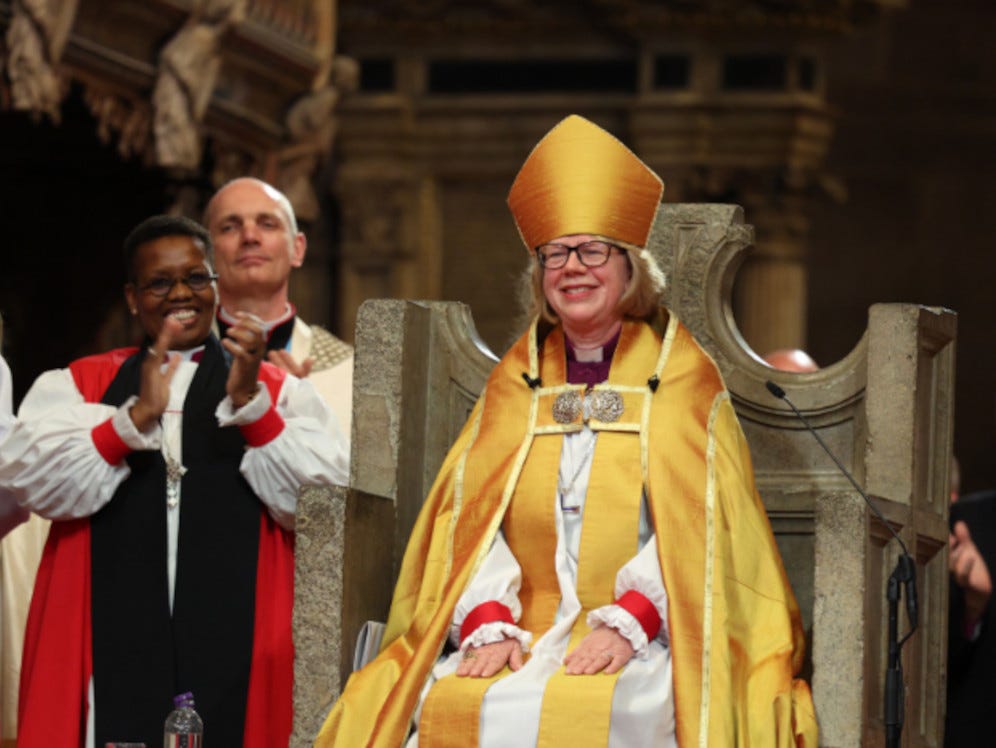
The sermon was no doubt carefully constructed and revised and edited to say something… without offending anyone, and therefore say very little at all. There was mention of Mary, and Jesus, and a few words about love, hope and joy were added to the mix. There was a Christian vibe to the message, but I think it’s fair to say that her homily was an exposition of her recent pilgrimage, rather than teaching from the Bible.
Of course, no sermon can say everything. We’ve all experienced the pew critic who expects a word by word and verse by verse exposition, or those waiting to hear, ‘shibboleth’. But one doesn’t need to be one of those listeners to realise some pretty big things were missing in what is meant to be the launch Christian sermon by the new leader of a global Christian denomination.
Lots of things were missing in Mullally’s sermon but 3 missing elements in particular speak volumes about Canterbury today
First of all, there was no mention of the world’s majority Anglicans who no longer recognise Canterbury. At one point Mullally did say,
‘Some of our Anglican brothers and sisters are unable to be here today due to the war in the Middle East and the Gulf. We pray for them without ceasing, and for all those in war-torn areas of the world, in Ukraine, in Sudan, and Myanmar – that they would know God’s presence with them, just as we pray for peace to prevail.’
Fair enough. These folk should be acknowledged. But her comments are also performatory gaslighting. What of the Anglican brothers and sisters unable to be present because of Canterbury’s persistent errant theology and agenda? There was zero mention of the many senior bishops and archbishops who chose not to attend. Something like 70-80% of the world’s Anglicans no longer recognise Canterbury because of their persistence in redefining biblical ethics and the Gospel. It doesn’t take a student of church history to understand why the new archbishop avoided this one.
Second, and related to the first absentee, there was no mention of the doctrine(s) that have led to the ills and fracturing of the Anglican Communion. If one was unaware of the theological debates over the the last 20+ years, one might be forgiven for thinking everything is wonderland in the Church of England.
Isn’t odd that the major issue facing Anglicanism today was utterly ignored in Mullally’s inaugural address!
Third, and most troubling of all, there was no Gospel. Certain Bible words were mentioned , but that doesn’t make it Gospel.
The Gospel of Jesus Christ is everything. The Gospel is central. The Gospel is foundational. And yet it was not to be found in this sermon. There were suggestions of how Mary and Jesus are a great example to follow (yes, of course), but the gospel isn’t, ‘do Mary’ or ‘be like Jesus’.
The sermon less resembled the Apostolic preaching of the cross and was akin to old fashioned liberal social enterprise messaging. The sermon would have made Pelagius chuffed: join together with God in a near semi-pelagian style religion.
Again, one doesn’t want to get hung up by every Bible word and category as though the only faithful sermon is the one mentioning ‘penal’ or inerrancy’. But will listeners go away thinking, my sin is foremost against God and only the death of Christ can atone for sin? Will those in the dusty wooden pews go home realising Jesus is Lord and our rebellion against God is so perilous that the cross was necessary for our redemption? Will the clergy be reminded of God’s mandate to preach Christ in order to see people converted and turning to the living God?
Jesus launched his public ministry with a sermon,
“The time has come,” he said. “The kingdom of God has come near. Repent and believe the good news!”
What about Peter? At Pentecost, he declared,
“Repent and be baptized, every one of you, in the name of Jesus Christ for the forgiveness of your sins. And you will receive the gift of the Holy Spirit. The promise is for you and your children and for all who are far off—for all whom the Lord our God will call.”
And Paul, who resolved to know nothing except Jesus Christ and him crucified?
When the Apostle Paul explained his modus operandi , Christian leaders are meant to follow suit, not ignore,
‘For Christ did not send me to baptize, but to preach the gospel—not with wisdom and eloquence, lest the cross of Christ be emptied of its power.’
It’s not that Mullally’s words were technically false, but they are misleading and ultimately empty of power. To rehash a popular meme, the homily was very much like offering bottles of water to the passengers on the Titanic.
We have this weird way of assessing what we approve of, forgiving and forgetting so long as a leader taps into some preference we hold dear. Paul wrote a entire letter to the Corinthians to correct their funky view of Christian leaders. Don’t confuse costumes with Christ centred Christianity. Performative religion (even if it’s heart felt) isn’t the same as the weakness and foolishness of the cross. We mustn’t allow our preferences on second order matters to become more important than the things of primary importance.
If first sermons are anything to go by, Sarah Mullally’s is signalling that Canterbury is on it’s way to joining the Titanic. In the mean time, there are faithful parishes dotted around England, and in Uganda and Nigeria and Egypt, and across Australia and Egypt, where the message of Christ crucified can still be heard, and praise God, for there is the power of God and the wisdom of God.
You can read the sermon in full here:
https://www.archbishopofcanterbury.org/speeches/archbishop-sarahs-installation-sermon
As alternatives, preach only a few weeks earlier, this opening sermon at GAFCON 26 by Archbishop Most Rev. Henry Ndukuba
And the closing sermon given by Archbishop Laurent Mbanda of Rwanda: https://anglican.ink/2026/03/06/mbandas-fiery-closing-sermon-at-g26-choose-this-day-whom-you-will-serve/
While this sermon on 1 Corinthians 5 doesn't refer to the above issue, the Bible passage is relevant
https://youtu.be/u_--_8YwQUM?si=Dcbo4dn4OnAxJiS1
Makes you want to become a Baptist eh.
When the brain gets cancer you do your best with the knife and the chemicals, but in this case you cut loose and replace with Jesus as head.
Choose your own mixed metaphor but yes, let's install a new head.